Bedrock

by LearnSATMath

The only SAT Math platform you'll ever need.

Trusted by 81,454 students

Eric, creator of Bedrock and LearnSATMath

I'm Eric. Over the past few years, I've helped hundreds of students raise their SAT Math scores, and made YouTube videos at @LearnSATMath that have reached millions more.

Now I'm building Bedrock to turn my years of teaching into an interactive platform. With Bedrock Pro, you unlock the full curriculum of lessons, videos, practice problems, and exams, that adapts to your weaknesses.

Good luck on your SAT math journey!

The Complete Bedrock Curriculum

THE COMPLETE BEDROCKCurriculum

8 levels, 105 topics

Every student falls into one of 8 levels. Each level walks you through the lessons, drills, and problems built around your weaknesses, taking you up to the next level.

Explore the Course →

The Bedrock 125

THE BEDROCK125

Every problem on the SAT Math falls into one of 125 problem types. Drill these and you’re at a perfect score.

The first 40 of the 125 Bedrock problems, colored by difficulty

1: Plugging into a function, easy, 12 variations
2: Intercepts of a function, easy, 10 variations
3: Solving for x given y, easy, 9 variations
4: Table Regressions, easy, 7 variations
5: Function Transformations, medium, 13 variations
6: Stretched & Compressed Functions, medium, 6 variations
7: Custom Regressions, hard, 6 variations
8: Radical Models, hard, 3 variations
9: System of Equations, easy, 8 variations
10: Algebraic Systems of Equations, medium, 7 variations
11: Lines in terms of real numbers, medium, 3 variations
12: English to Math, easy, 14 variations
13: Inequalities, medium, 10 variations
14: Consecutive odd/even integers, medium, 3 variations
15: Inequalities Graphically, medium, 5 variations
16: Systems of Inequalities, hard, 5 variations
17: System of 1 Equation & 1 Inequality, hard, 3 variations
18: Single Variable Equations, easy, 12 variations
19: Single Variable Equations with a Constant, medium, 4 variations
20: Rearranging Terms, hard, 10 variations
21: Simple Equivalent Expressions, easy, 7 variations
22: Exotic Equivalent Expressions, easy, 9 variations
23: One Variable in Disguise, hard, 5 variations
24: Number of Solutions, easy, 10 variations
25: Equivalent for all x, medium, 5 variations
26: Slope, medium, 16 variations
27: Linear Functions, easy, 5 variations
28: Linear Word Problems, easy, 8 variations
29: Interpreting Y-Intercept, medium, 5 variations
30: Standard Form Equation, easy, 12 variations
31: Constants in Linear Functions, medium, 6 variations
32: Standard Form - Infinite Solutions, hard, 5 variations
33: Parallel Lines, medium, 8 variations
34: Perpendicular Lines, hard, 8 variations
35: Percentages, easy, 15 variations
36: Reverse Percentage Example, medium, 5 variations
37: Hard Percentages, hard, 7 variations
38: Exponent Rules, medium, 8 variations
39: Mixtures, medium, 3 variations
40: Exponential vs Linear Growth, easy, 8 variations
Try them free →
Answering problem 47, Integer Factors, on Bedrock

Pro Problems

PROPROBLEMS

Explanations for all 847 problems

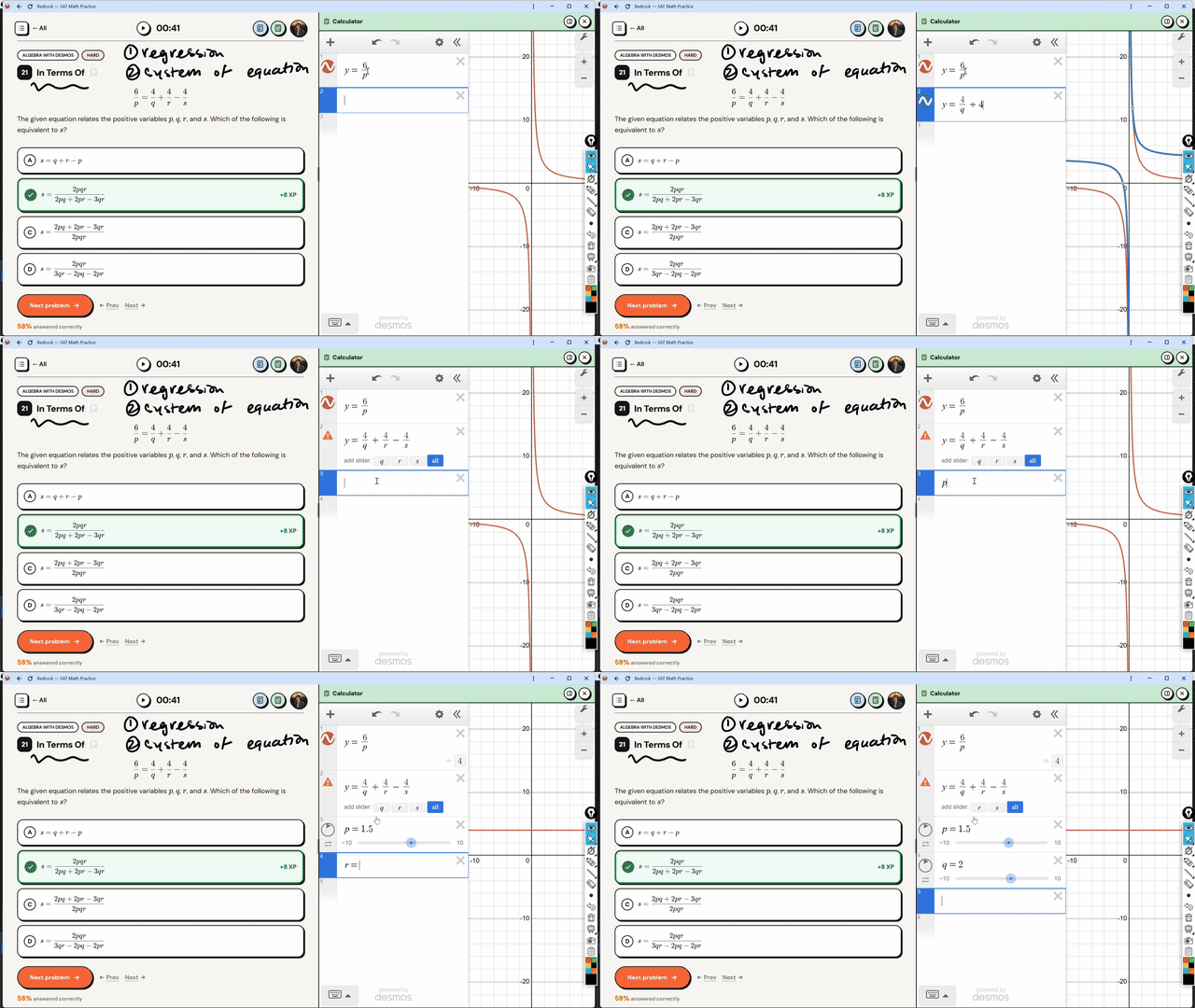
Every Pro problem comes with a full written solution, showing the optimal approach(es) for each problem. Unlike most platforms, Bedrock solutions always include Desmos when applicable.

TryPro Problems →
Angles & Trianglesmedium
Problem 77k

Similarity

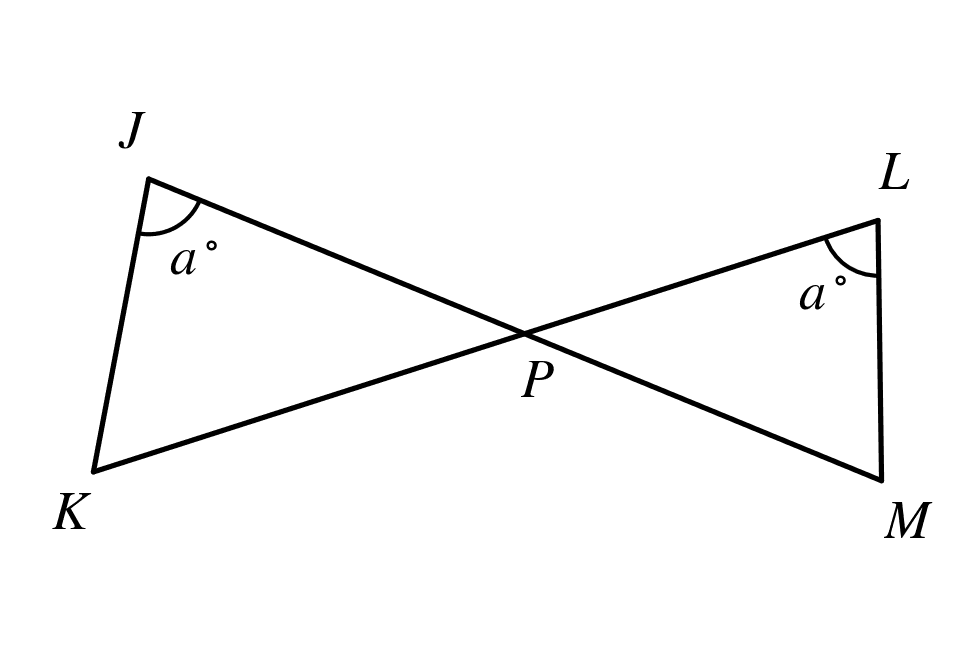
Figure for Similarity

In the figure shown, JM‾\overline{JM} and KL‾\overline{KL} intersect at point PP, JP=45JP = 45, LP=18LP = 18, JK=40JK = 40, and KP=60KP = 60. What is the length of LM‾\overline{LM}?

Note: Figure not drawn to scale.

Solution

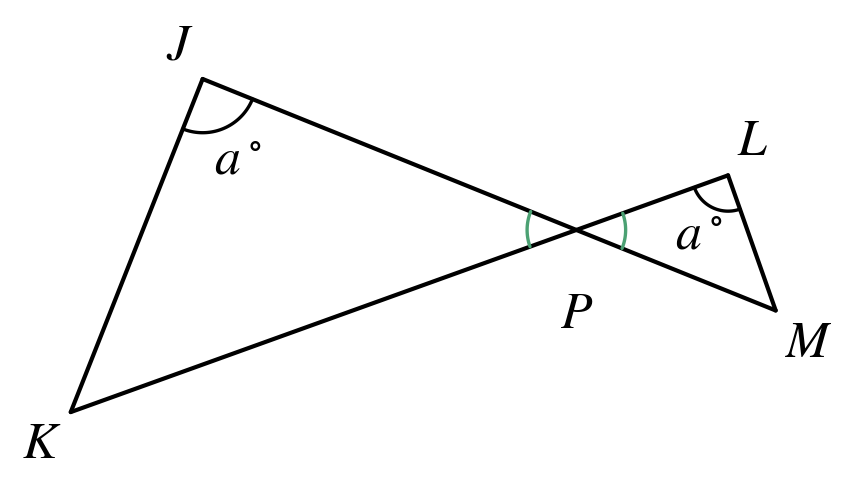
Step 1. The figure marks angle JJ and angle LL with the same a∘a^\circ. ∠JPK\spotgreen{\angle JPK} and ∠LPM\spotgreen{\angle LPM} are vertical angles, so they're equal too. Two matching angles are enough for similarity, so triangle JKPJKP is similar to triangle LMPLMP, with JJ corresponding to LL, KK to MM, and PP to PP.

Segments JM and KL crossing at P, with the a-degree marks at J and L and the vertical angles at P arced in green

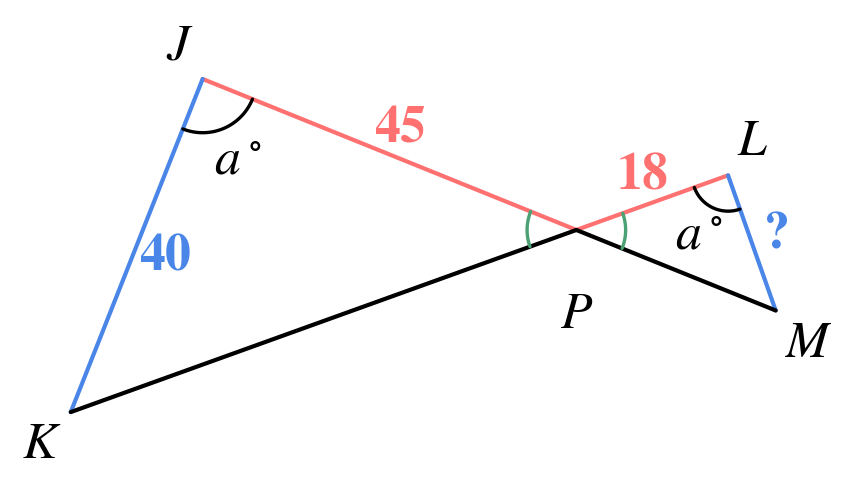
Step 2. Similar triangles are scaled copies, so every side is multiplied by the same number. Pair the sides by their endpoints. JJ and PP match LL and PP, so JP‾\spotred{\overline{JP}} corresponds to LP‾\spotred{\overline{LP}}. JJ and KK match LL and MM, so JK‾\spotblue{\overline{JK}} corresponds to LM‾\spotblue{\overline{LM}}.

The same figure with JP and LP in red labeled 45 and 18, and JK and LM in blue labeled 40 and a question mark

Step 3. The problem gives us JP=45\spotred{JP} = 45 and LP=18\spotred{LP} = 18, so triangle LMPLMP is triangle JKPJKP scaled by 1845\dfrac{18}{45}. Call that number kk.

Step 4. Every side scales by that same kk, and the problem gives us JK=40\spotblue{JK} = 40:

LM=40k\spotblue{LM} = 40k
k=1845\displaystyle k = \frac{18}{45}
40k\displaystyle 40k

LM‾\overline{LM} has a length of 1616. Choice B.

Plus 127 video explanations by Eric
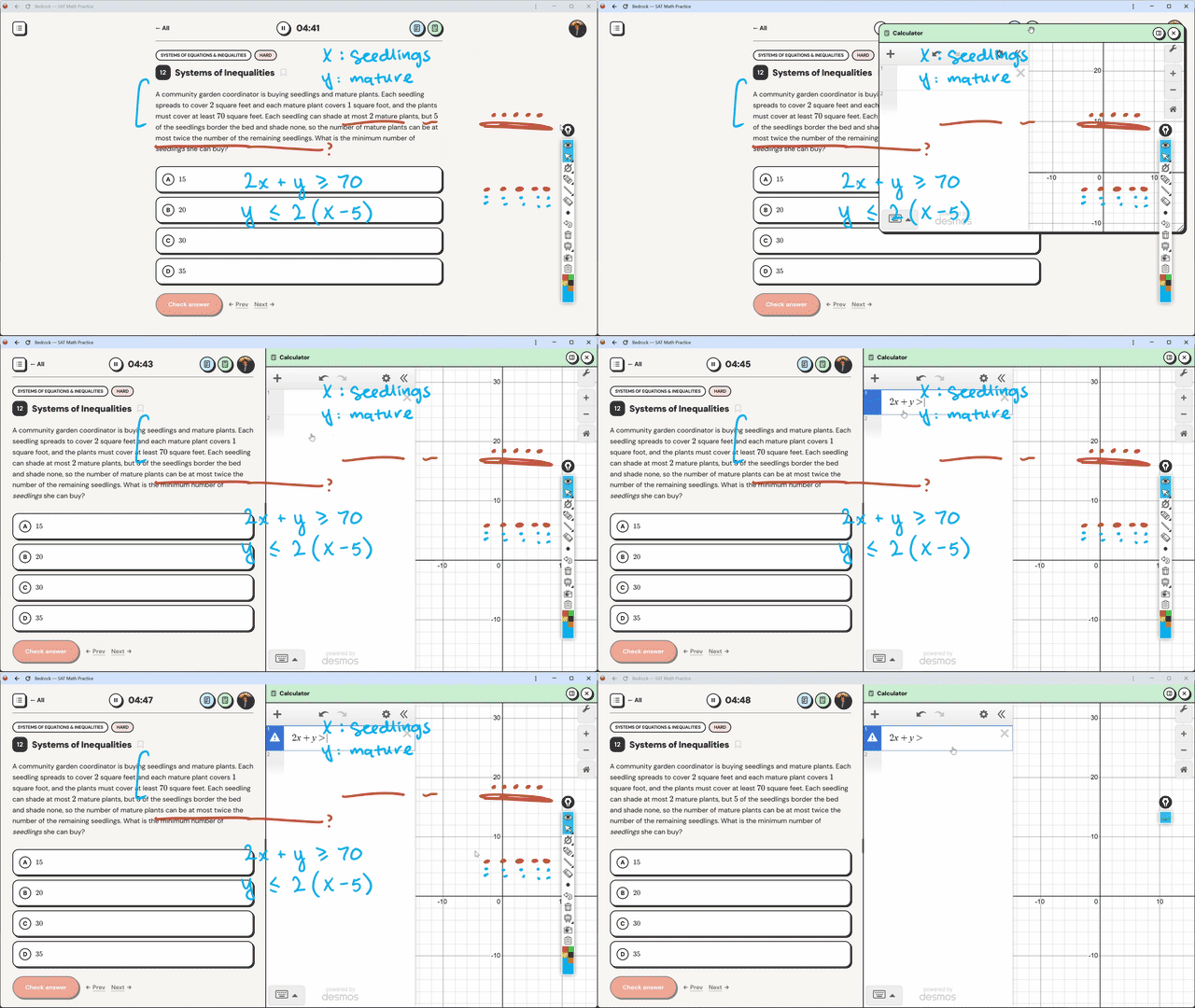
Preview of the Bedrock Pro video explanation for Systems of Inequalities
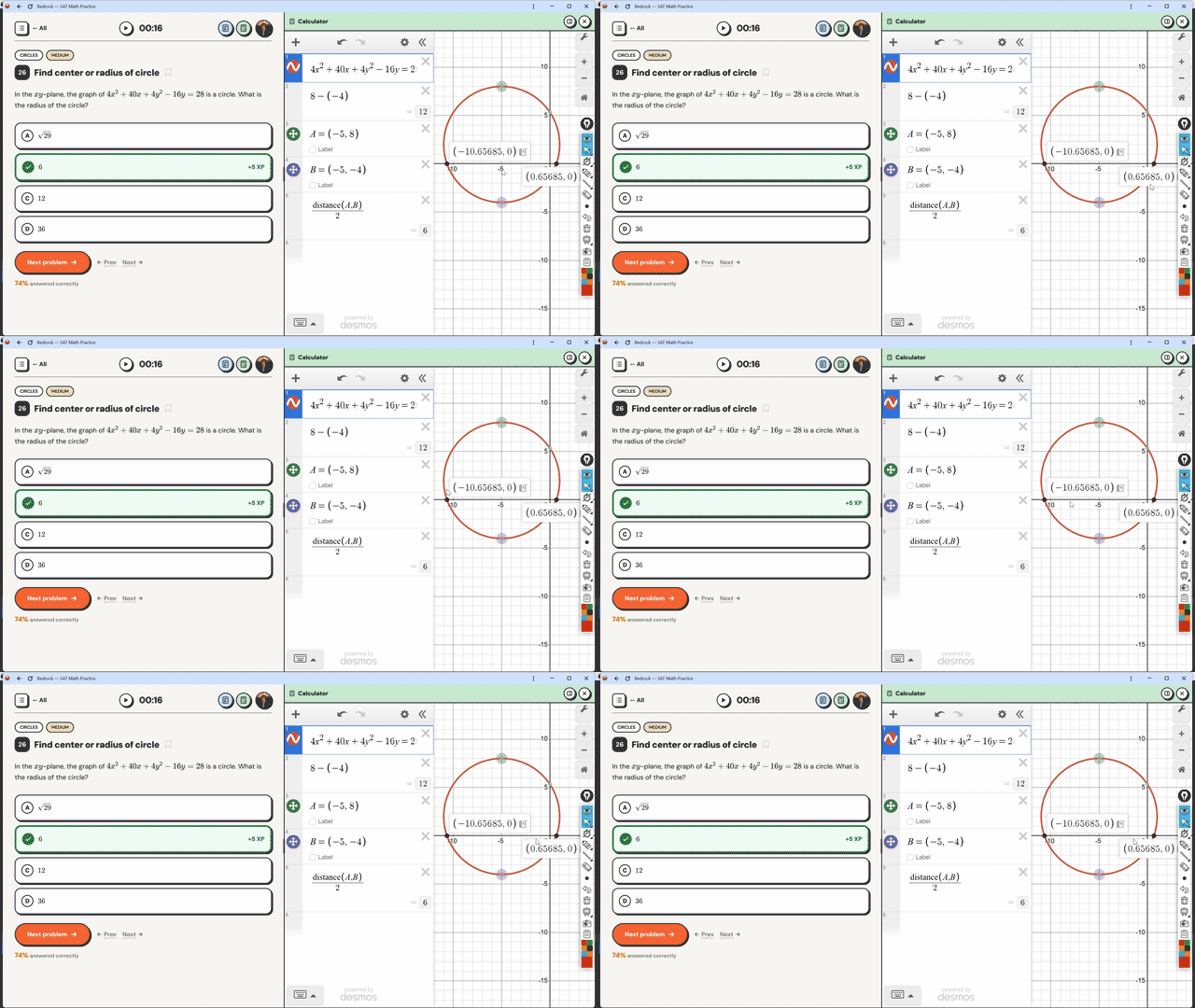
Preview of the Bedrock Pro video explanation for Find center or radius of circle
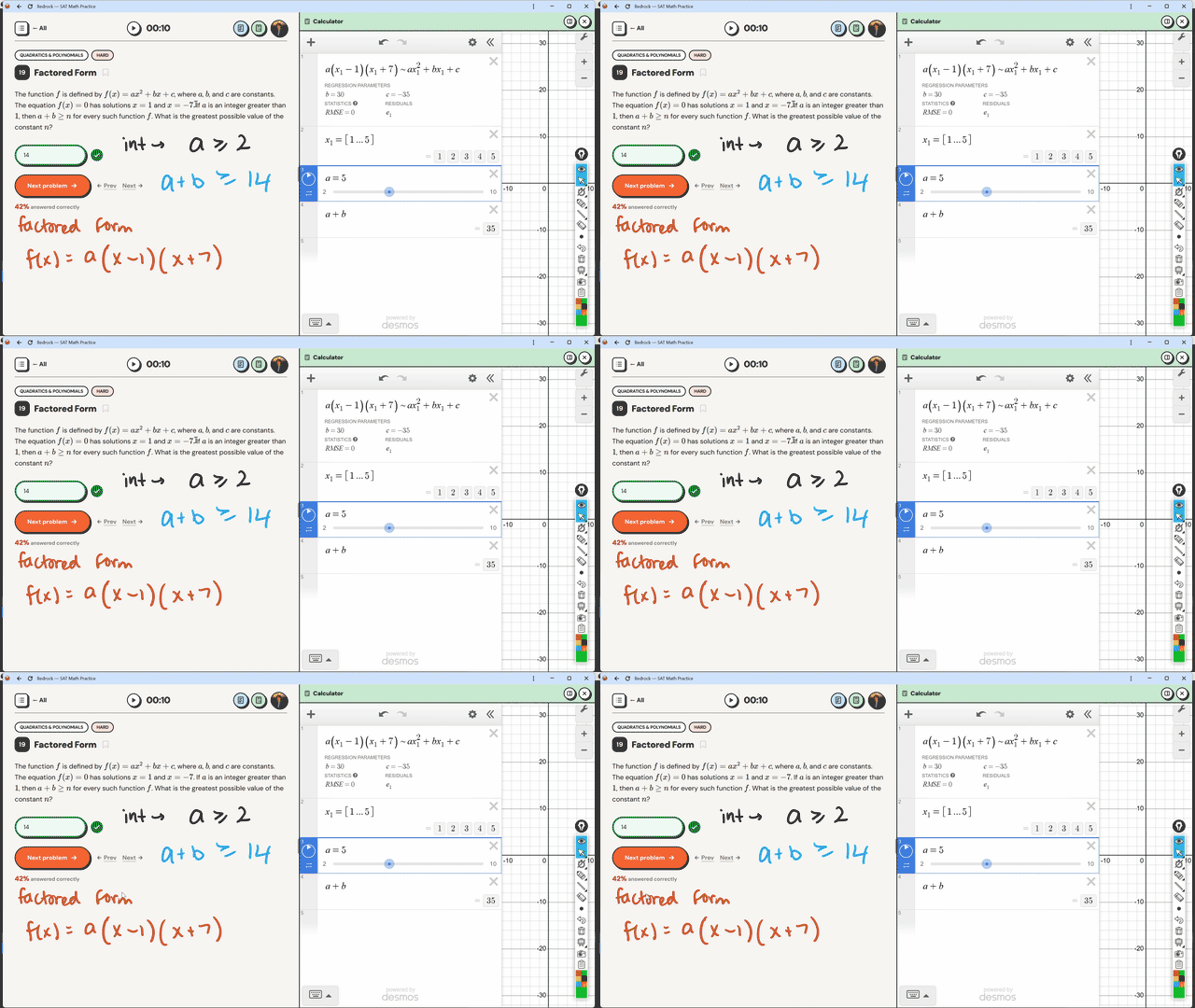
Preview of the Bedrock Pro video explanation for Factored Form
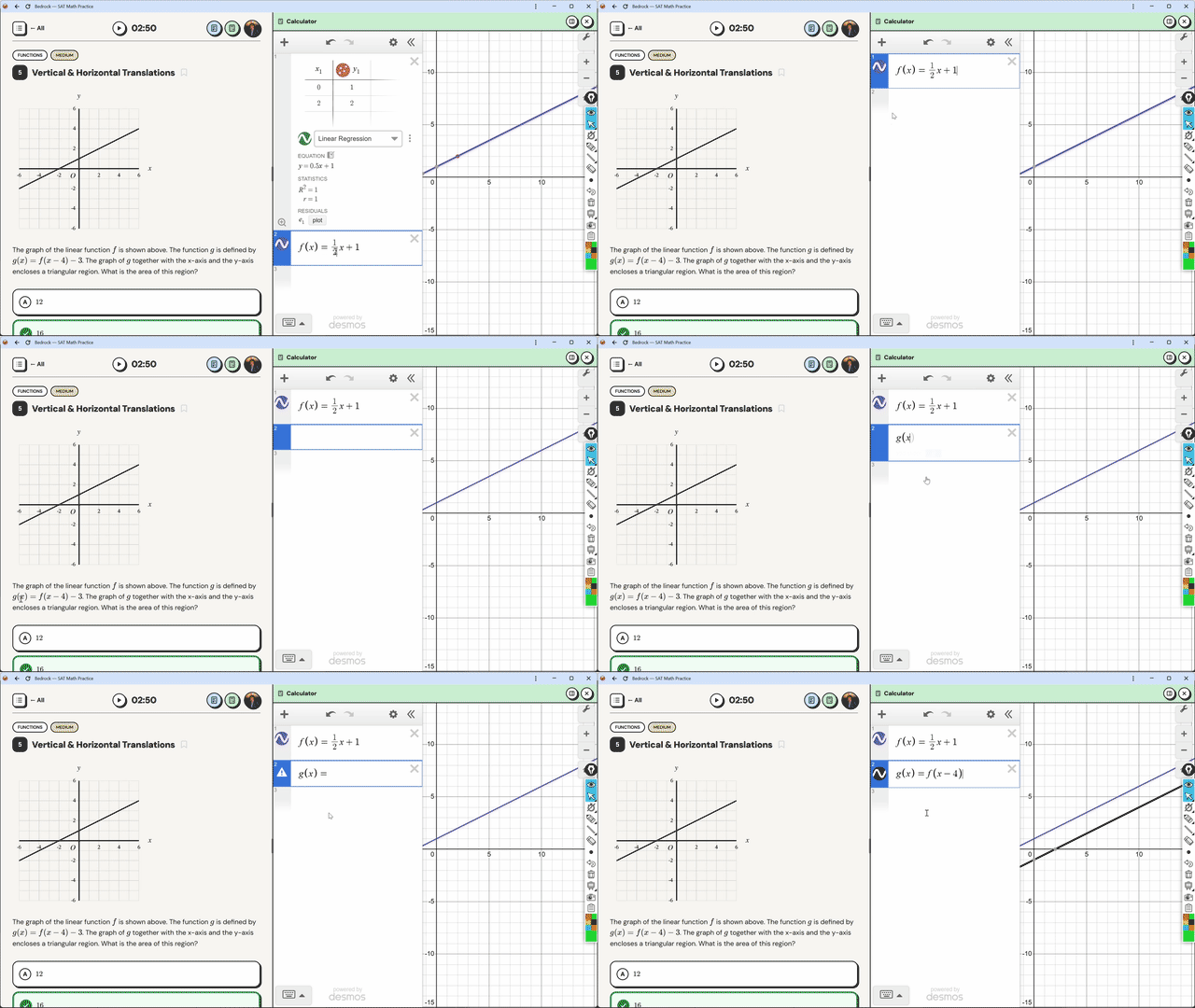
Preview of the Bedrock Pro video explanation for Vertical & Horizontal Translations
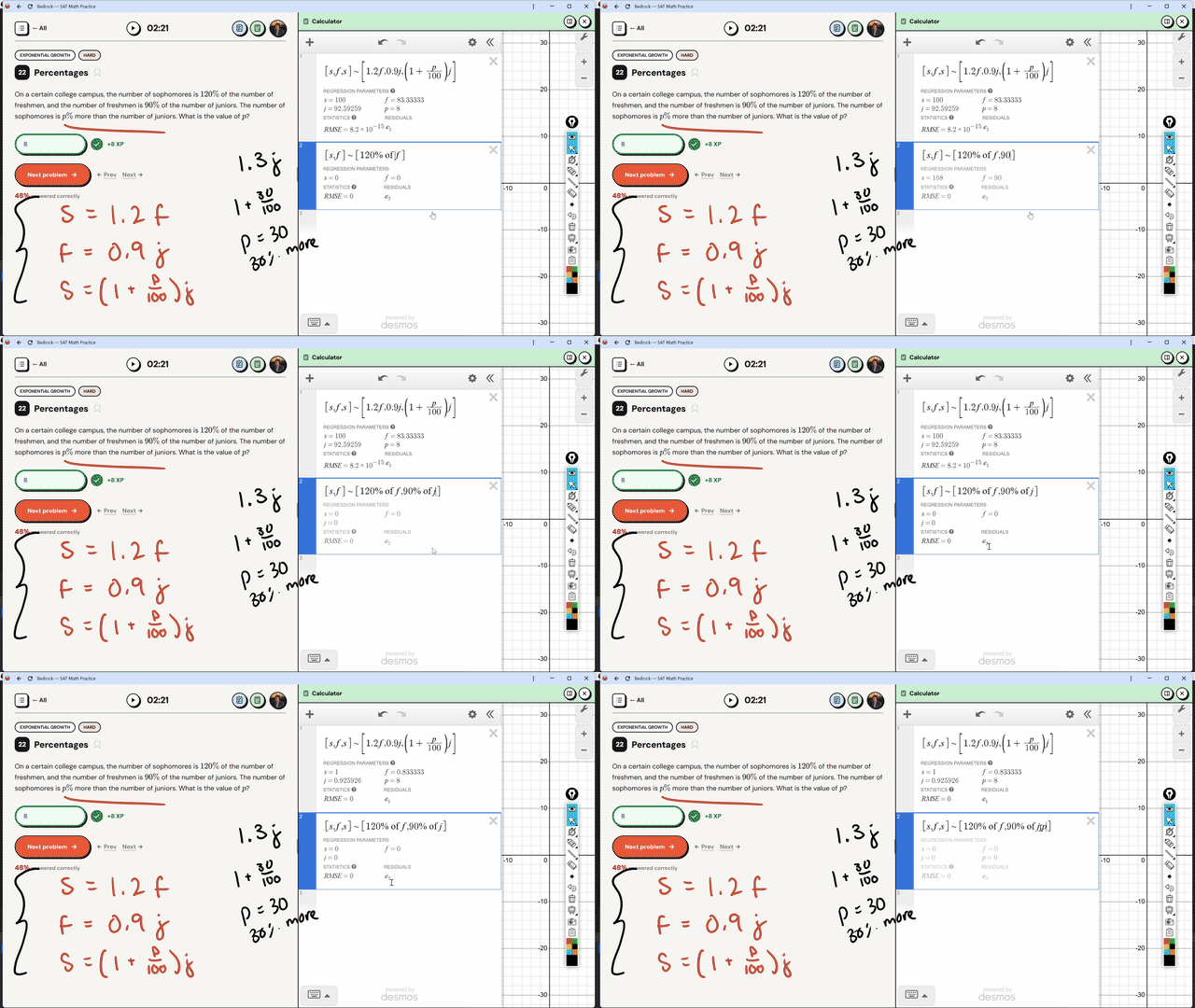
Preview of the Bedrock Pro video explanation for Percentages
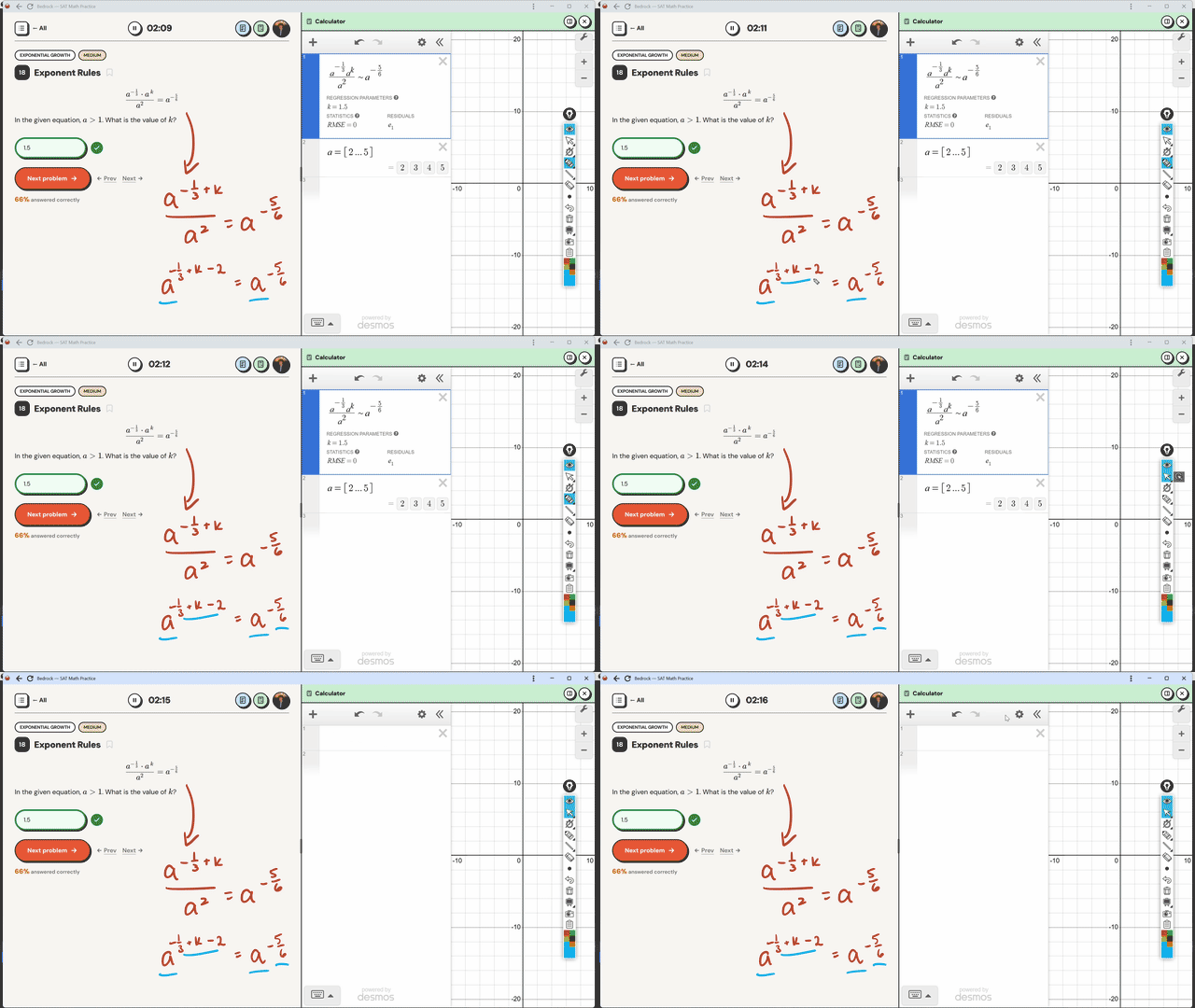
Preview of the Bedrock Pro video explanation for Exponent Rules
Preview of the Bedrock Pro video explanation for In Terms Of
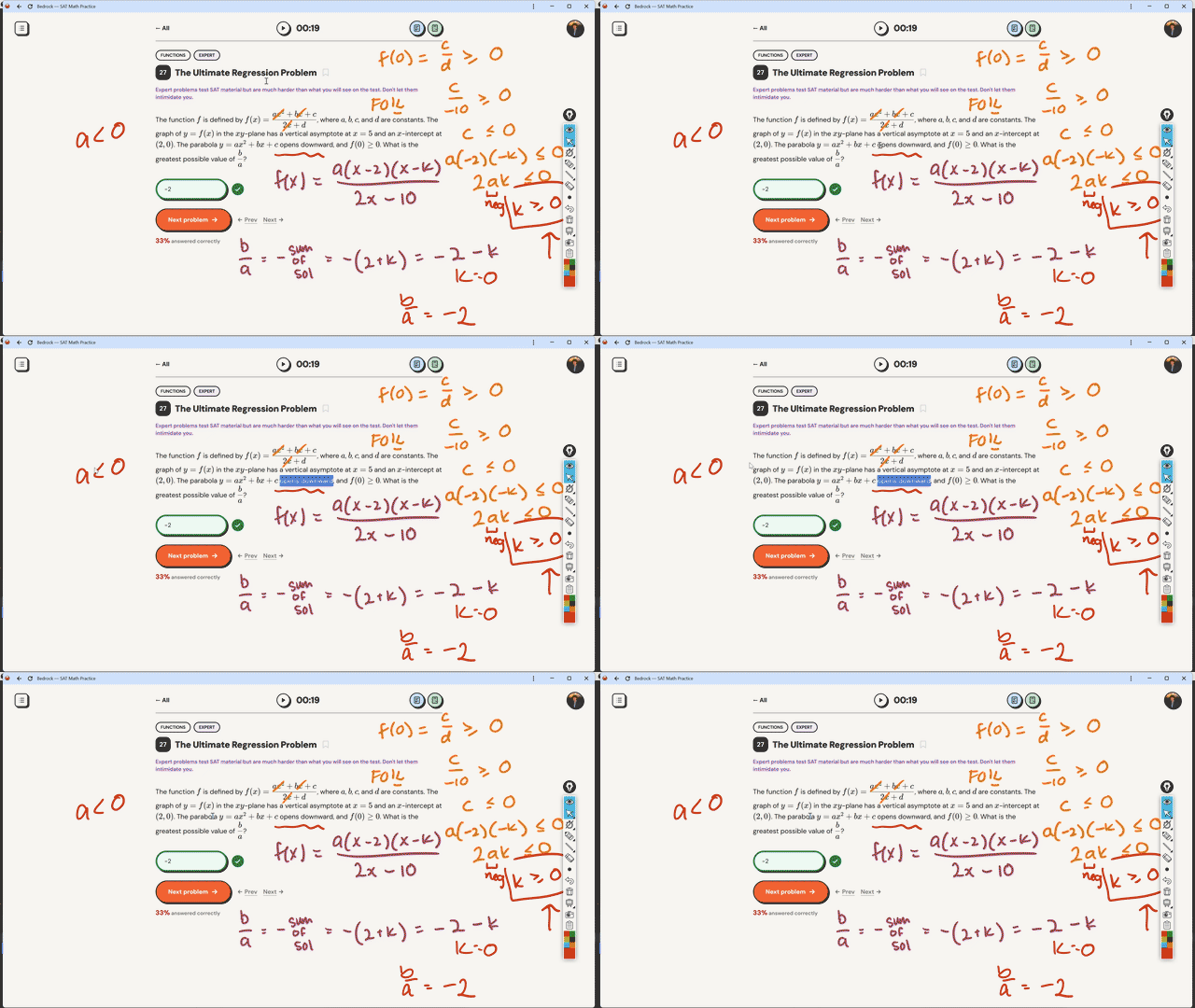
Preview of the Bedrock Pro video explanation for The Ultimate Regression Problem

Practice Tests

Practice Tests

4 tests, as hard as the real SAT

Full-length and adaptive like the real SAT, and just as hard. Every test finds your weak spots and hands you the problems that fix them.

Take a practice test →
SAVE $225

Bedrock Basic

$0/mo

Free forever with an account

  • Problem sets for LearnSATMath videos
  • The Bedrock 125: one problem for every SAT Math problem type
  • 1 full-length practice test with explanations
Start free

Bedrock Pro

$79/mo

No commitment, cancel anytime

RECOMMENDED